
As an Amazon Associate I earn from qualifying purchases. This post may contain affiliate links.
Find out how to eat hachiya persimmons, how to ripen them, and exactly how to tell when they’re ready. Wait until the flesh turns to jelly and you’ll get a fruit that tastes like nature’s candy.
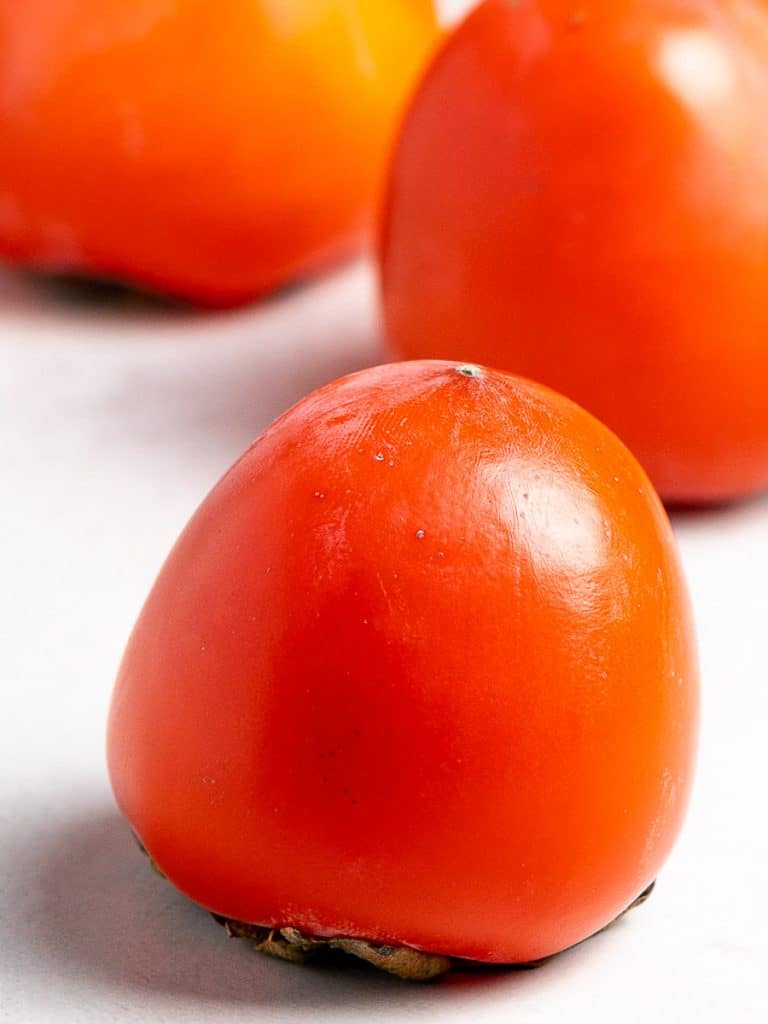
Hachiya persimmons are one of the most sought-after fruits of late fall and early winter. When fully ripe, the flesh turns soft and jelly-like, with a honey sweetness that reminds me of a ripe tropical fruit.
There’s one rule that makes or breaks the whole experience: you have to wait until they’re completely soft. A hachiya persimmon starts out hard and firm, and if you bite into it at that stage, you’ll get a dry, chalky, cotton-mouth feeling that ruins the fruit for a lot of people. That reaction comes from the tannins, and it disappears completely once the fruit ripens. More on how to get there below.
The season is short, so if you spot these at the supermarket, grab them before they’re gone.
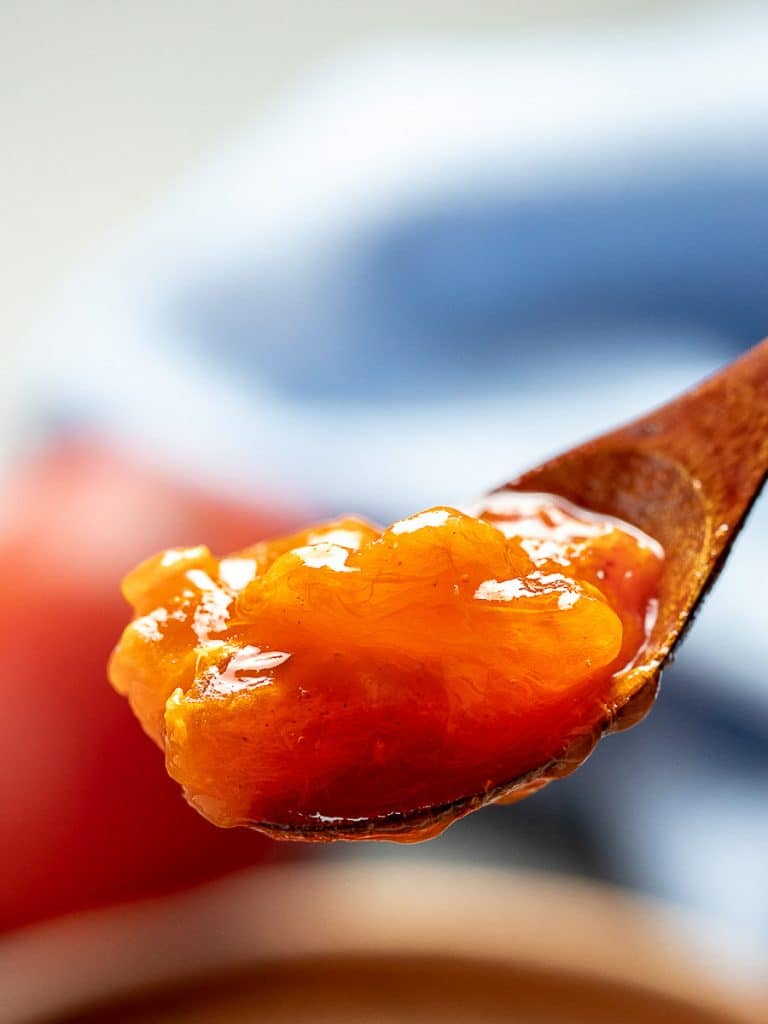
Hachiya vs. Fuyu: How to Tell Them Apart
Before anything else, make sure you actually have a hachiya. The two persimmons you’ll find at the store look similar and get mixed up constantly, but they’re eaten in completely different ways.
Hachiya persimmons are tall and taper to a point at the bottom, shaped like an acorn or a spinning top. They’re astringent, which means they have to be fully soft and ripe before you eat them.
Fuyu persimmons are short and squat with a flat bottom, shaped like a small tomato. They’re non-astringent, so you can eat them firm and crisp, skin and all, like an apple.
If you bought a firm persimmon and it’s flat on the bottom, it’s a fuyu and you can eat it right now. If it’s pointed at the bottom and still firm, it’s a hachiya, and you need to wait. This one difference is the reason so many people think they dislike persimmons: they bit into a firm hachiya that was never meant to be eaten that way.
Why Unripe Hachiya Persimmons Taste So Bad
An unripe hachiya is loaded with soluble tannins. When those tannins hit your mouth, they bind to the proteins in your saliva and leave a dry, fuzzy, chalky coating on your tongue. It’s not a flavor so much as a texture, and it can linger for a while.
As the fruit ripens, the tannins bind together into larger molecules that no longer react with your mouth. That’s the whole reason ripeness matters so much here. A ripe hachiya isn’t just sweeter than an unripe one, it’s a genuinely different eating experience. Wait it out and you’re rewarded. Rush it and you’ll understand why some people swear off persimmons entirely.
How to Buy Them
Look for hachiya persimmons with smooth skin, free of bruises or open cuts. Don’t be put off by dark blotches on the skin, since those are usually just sun spots and the fruit is fine underneath. Skip any that have already split open or feel mushy in spots, since those are past their prime.
At the grocery store, they’ll almost always be sold hard and firm. This is normal. They’re picked and shipped while still hard because ripe hachiyas are far too delicate to travel. You’ll be doing the ripening at home.
Once you bring them home, give them a good wash while they are still firm. They become very delicate once fully ripe so it’s best to wash them while they are underripe.
How to Ripen Hachiya Persimmons
Left on their own, hachiya persimmons can take anywhere from a few days to two weeks to ripen, depending on how firm they were when you bought them. If they feel rock hard, plan on the longer end.
To speed it up, use the paper bag trick: place the persimmons in a single layer inside a paper bag or a container along with an apple or a banana. Keep them at room temperature and leave the bag loosely closed so a little air can move through. The apple and banana give off ethylene gas, which speeds up ripening. Check every couple of days.
The freezer shortcut: if you’re impatient, freeze a firm or partly ripe hachiya whole for at least 24 hours, then thaw it completely. The freeze-and-thaw breaks down the cell walls and knocks out the astringency, leaving you with soft, scoopable flesh. The flavor won’t be quite as deep as a naturally ripened one, but it’s a good option when you don’t want to wait, and it’s ideal for baking or smoothies.
When Are Hachiya Persimmons Ripe?
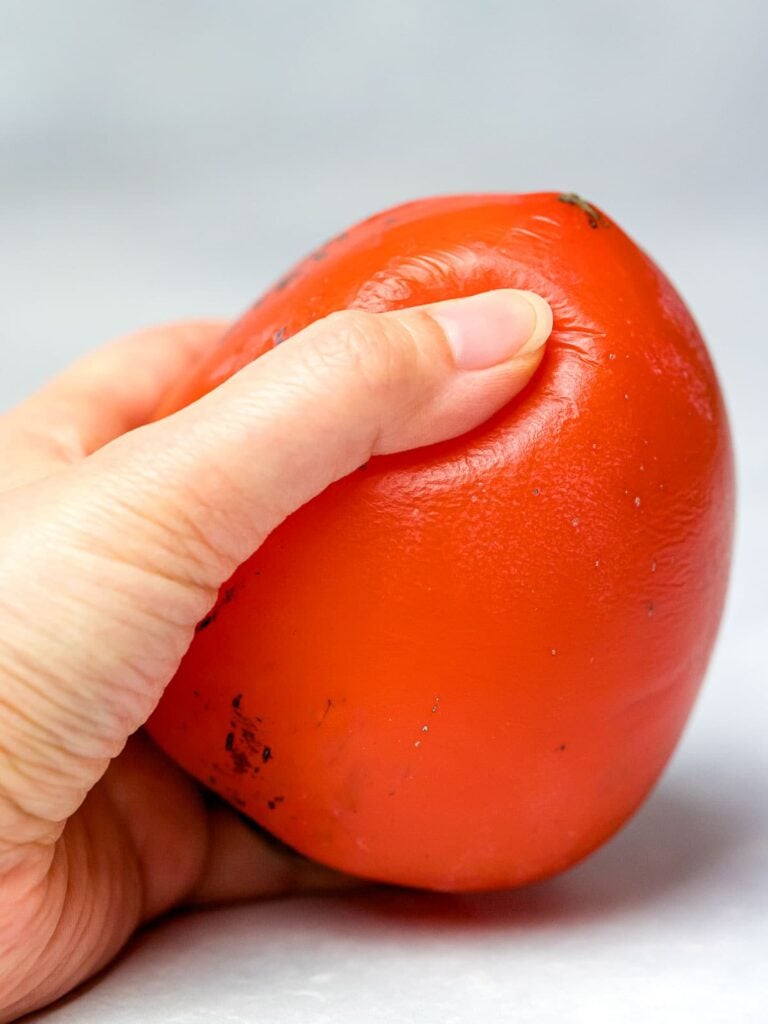
A ripe hachiya feels like a water balloon that’s about to burst. The inside turns to a jelly consistency, and the skin often looks slightly translucent and may wrinkle a little.
Here’s the test: hold the fruit in your palm and gently press it. It should give completely, with no firm spots anywhere. Pay special attention to the flesh around the stem, since that’s the last part to ripen. If any section still feels solid, give it another day or two.
The old saying is that a hachiya is ready when it looks almost too ripe to eat. When in doubt, wait. An extra day of patience is always better than a mouthful of tannins.
How to Eat Hachiya Persimmons
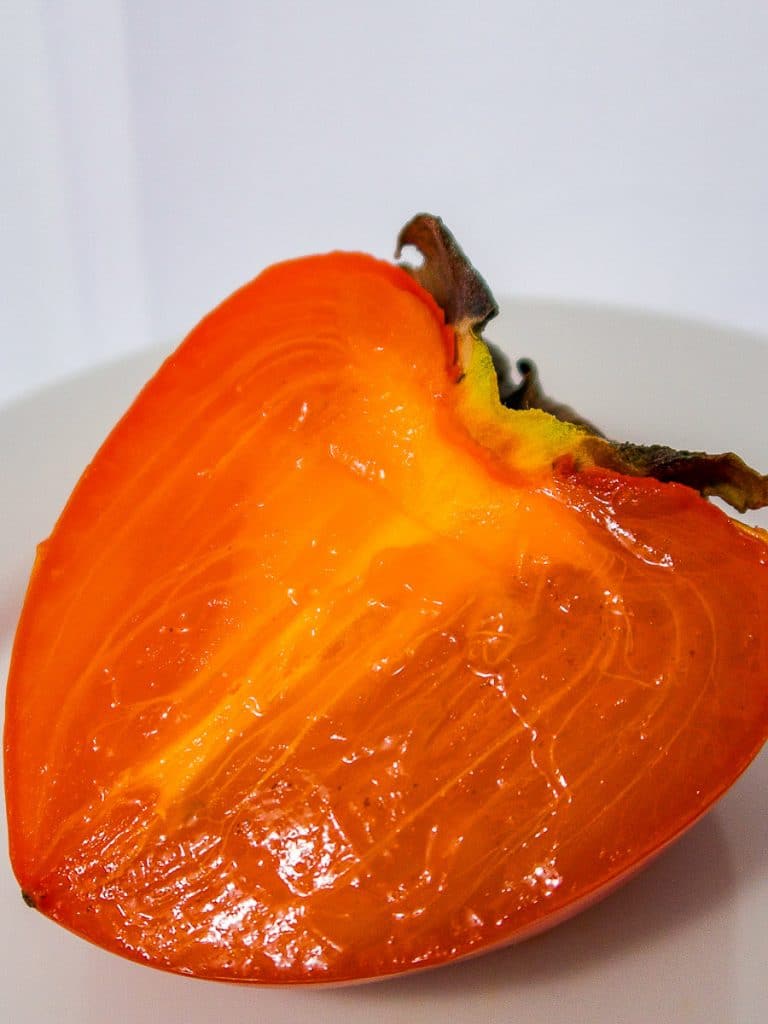
My favorite way is the simplest: cut it in half and scoop out the flesh with a spoon. That’s it! The texture is soft and custardy, and the sweetness is incredible. Because ripe hachiyas are so juicy, it’s worth doing this over a bowl or the sink.
Skip the skin on a hachiya. Unlike a fuyu, the skin here isn’t pleasant to eat, so scoop the flesh and leave the rest.
A few more ways to enjoy them:
- Frozen, like sorbet: once fully ripe, freeze them whole for 24 hours, then cut in half and scoop. The texture comes out like creamy soft serve, and it’s one of my favorite treats. Your taste buds will thank you.
- Mashed into baked goods: scoop the pulp and fold it into quick breads, muffins, and cookies. This is the classic use for ripe hachiyas.
- Stirred into yogurt or oatmeal: the jelly-soft flesh mixes right in and adds natural sweetness.
- Blended into smoothies: thawed frozen hachiyas are perfect for this.
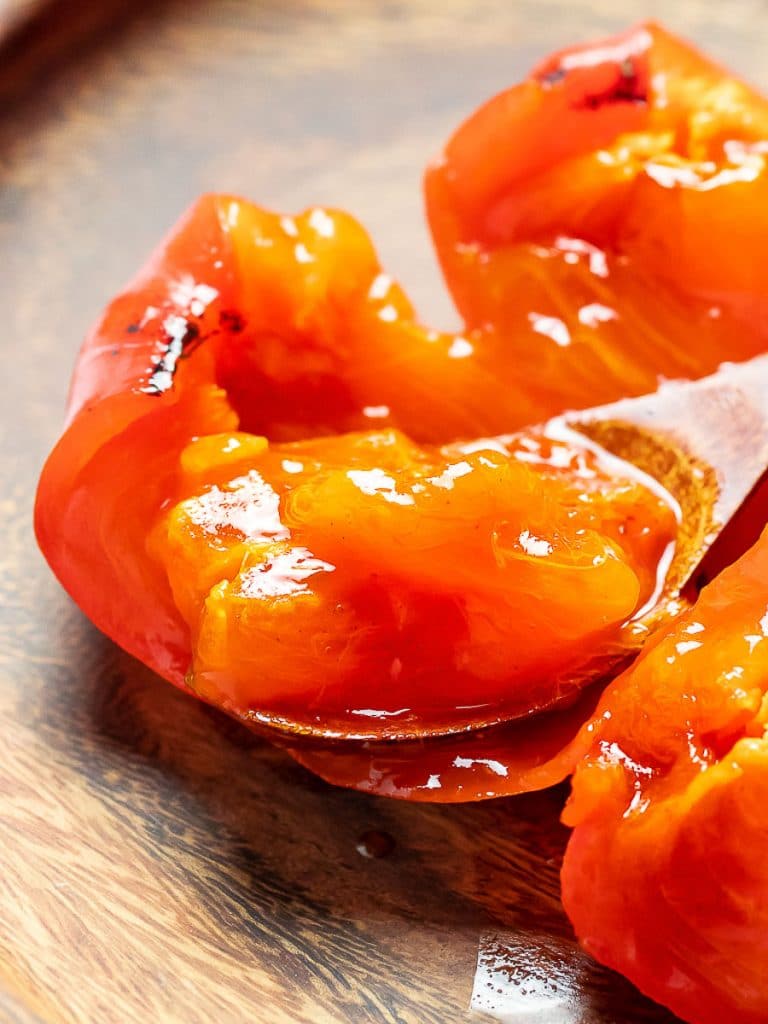
Korean Dried Persimmons (Gotgam)
In Korea, hachiya-style persimmons are enjoyed both fresh and dried. The dried version is called gotgam (곶감). To make it, the persimmons are peeled while still firm and hung on ropes until they form a natural sugar crust and turn soft and chewy.
Gotgam is the best dried fruit I’ve ever had. It tastes like candy and has a texture unlike anything else. If you see any at a Korean or Asian market, pick some up. The same tradition exists in Japan, where the dried fruit is called hoshigaki.
Are Hachiya Persimmons Good for You?
Hachiya persimmons are a good source of vitamins A and C, along with fiber and beta-carotene. That’s part of why frozen ripe persimmons make such a satisfying dessert: you get that soft-serve texture with the nutrition of whole fruit.
FAQ
No. Firm hachiyas are intensely astringent and will leave a dry, chalky feeling in your mouth. Wait until they’re completely soft and jelly-like before eating.
You ate it before it was fully ripe. The tannins in an unripe hachiya bind to your saliva and create that puckering, cotton-mouth sensation. A fully ripe hachiya won’t do this.
It’s best to skip it. Hachiya skin isn’t pleasant to eat, so scoop out the soft flesh with a spoon instead.
Put them in a paper bag with an apple or banana at room temperature and check every couple of days. For an even faster fix, freeze a firm one for 24 hours and thaw it completely.
Anywhere from a few days to about two weeks, depending on how firm they were when you bought them.
Hachiyas are acorn-shaped, astringent, and must be eaten soft. Fuyus are squat and flat-bottomed, non-astringent, and can be eaten firm like an apple.



I have a tree and look forward to my crop every year. I eat with the skin. Some get “sunburned” by the exposure to sun, but it is fine eat that way. Still have quite a few slowly ripening. I planted a tree years ago because I live them so much. Very healthy.
I froze the persimmons as recommend led and they were so good! Such a delicious sweet treat – and healthy!
Thanks Belinda! So happy you enjoyed it! Freezing ripe persimmons is such a great way enjoy it!
Persimmons are one of my favourite fruits – I love all of your tips here for how to enjoy them at their best!